Upgrades
Lithium Batteries
Upgrading from flooded lead-acid batteries to lithium batteries has many advantages.
Design Considerations
Batteries
- It is best to have as few batteries in the system as possible in order to create a balanced circuit for charging and discharging. Instead of connecting several low voltage batteries in series, your new system should have one or two (in parallel) 36V/48V batteries.
- LiFePO4 batteries have a greater energy density than lead acid batteries, so you should not need more than one or two batteries. Consider how this affects weight distribution.
- In order to enable balanced charging and discharging, batteries must be identical and must be installed at the same time.
- LiFePO4 batteries come in a variety of non-standard sizes. Consider the space you have to work with.
- Each battery will likely have an internal Battery Management System (BMS) and a State of Charge (SoC) display. The SoC display may need to be mounted somewhere within the limitations of the supplied wiring harness.
Circuit Design
-
Proper circuit protection is especially important due to the high energy density of
Li-Ion batteries.
Here is a good guide
 to help with your design.
-
If you will have multiple batteries, bus bars will allow for more equal current
distribution.
- The original implementation used several wires in parallel between the batteries and components. If you are going to use central buses or posts, you will need to run larger wiring between the batteries and buses since these individual wires will be carrying as much current as the multiple parallel wires they are replacing.
-
Battery cables leading to the bus must use identical wire and be the same length
in order to have the same resistance. This allows for balanced charging and
discharging.
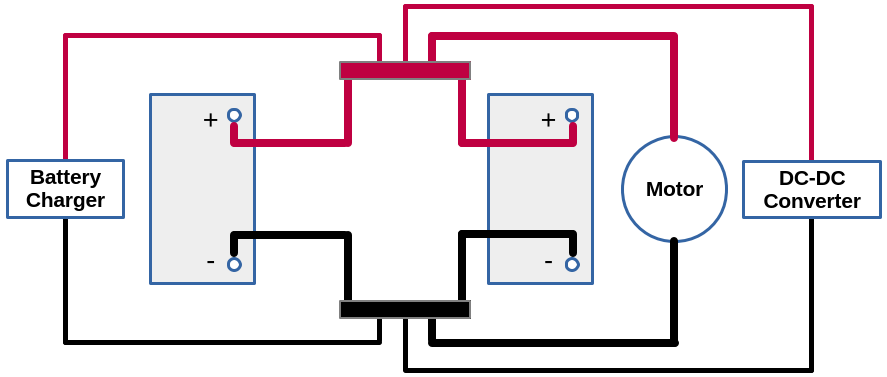
- LiFePO4 batteries require a different battery charger than flooded lead acid batteries.
- When implementing your new system, address electrical issues in the original Duffy implementation.
- Improve circuit protection and maintainability by adding a fuse panel.
Components
- Use high quality marine components throughout your new system. Companies like Epoch Batteries, Blue Sea, and Victron are highly regarded. Some Epoch batteries have internal fuses to allow for a cleaner implementation.
- 48V is much more common today than 36V systems. If you have a 36V system, consider upgrading or using components that can work with either 36V/48V for a future upgrade. Some motor controllers, motors, and contactors used in 36V systems are already rated for 48V.
Implementation
- Trace and label wires before reconfiguring.
- Duffy used expanding foam between some interior and exterior surfaces, trapping wiring in-place and making routing new wiring more difficult.
- The main wire harness was bundled before installation under the floor, so some wires that are no longer used will need to be abandoned instead of removed.
- Remove abandoned wiring left from your redesign and a history of boat maintenance and improvements.
- When using more than one battery, charge them independently to within 1% SoC of each other before installing them.
Reference
The following information is what I found on our boat. Your situation could be different.
Battery Taps
Our boat had three 12V taps and four 36V taps.
Loads
12V Circuits
Here is a table showing 12V circuit loads
36V Circuits
| Device | Amps | Notes |
|---|---|---|
| Motor & Controller | 75 | Full throttle |
| DC-DC Converter | 20 | Max rating. Realistic load <8A |
| Cabin Heater 1 | 15 | 16.1 at startup |
| Cabin Heater 2 | 15 | 16.1 at startup |
| 125 |